Small fleets pay more per gallon than large carriers due to four fundamental factors: retail versus negotiated pricing, volume tiering, fuel surcharge lag, and access to hedging. Pooling fuel purchasing power through a shared network closes much of this structural gap.
Two trucks fill up at the same truck stop on the same day with the same grade of diesel. One driver works for a 500-truck carrier. The other works for a five-truck operation down the street. The receipts don't match. That gap isn't random.
If you manage a small operation, fleet cost reduction often starts with noticing your fuel cost per mile is inching up beyond what published pump prices suggest. You may set your budget using the posted per-gallon rate, yet your real-world fuel outlay ends up noticeably higher. Even if you plug your data into a fuel cost calculator based on national average prices, the final total still won't line up with what you truly spend to haul freight.
This is the exact gap Nomad's network pricing was designed to close.
It’s not a question of vendor loyalty, weak route design, or driver behavior. It’s a structural issue. Fuel is typically the second-largest variable operating expense for trucking fleets, after driver labor, so a small per-gallon difference that seems minor on paper can turn into a meaningful budget hit when spread across a fleet’s monthly miles.
Four factors drive what a fleet truly pays at the pump, and each one rewards size and volume. Getting clear on these levers is the first move toward meaningful fuel savings, savings that stay intact across a full year of price volatility, not just during one strong week.
The price shown on the sign is not what every customer actually pays. Big carriers almost never buy at retail. They purchase fuel at negotiated rates linked to a wholesale index, often with fixed discounts at certain sites across their network.
Smaller fleets, on the other hand, are much more likely to pay the stated pump price or receive a discount so modest it makes little real difference. The per-gallon fuel cost you see at the station is driven by retail margins, local competitive pressure, and near-term pricing volatility.
For a fleet operating five vehicles instead of five hundred, those factors generally are not negotiable.
Fuel sellers and truck stop networks set their prices around steady, high-volume buying patterns. When a carrier can promise reliable fill volumes across hundreds of sites, the retailer can forecast demand with more certainty. In exchange, the retailer provides pricing that’s closer to wholesale levels.
A small fleet doesn't generate that kind of predictable draw at any single location. Without volume to offer, there's nothing to negotiate with, so the fleet defaults to whatever the sign says. Over enough miles, that difference in fuel price compounds into a meaningfully higher total cost.
Fuel discount programs are tiered. The more fuel a fleet buys, and the more consistently it buys, the deeper the discount tier it qualifies for. This is standard practice across fleet management and fleet fuel programs alike.
A fleet purchasing 50,000 gallons per month operates in a very different tier from one purchasing 2,000 gallons per month. At the highest level, the cents-per-gallon discount can be meaningful and add up quickly.
At the lowest level, the savings often fade to almost zero, even if both fleets are enrolled in the same program.
Tiering is not meant to punish smaller carriers. It’s just the standard way volume-based pricing works across most industries. Still, the real-world outcome is similar no matter the intent: a small fleet’s fuel expense remains structurally higher because it can’t buy enough volume to qualify for lower, deeper pricing tiers.
This is one of the clearest reasons two fleets buying the same fuel on the same day end up with different effective costs. Volume, not negotiating skill, sets the ceiling on fleet costs.
Fuel surcharges are intended to shift rising fuel costs from the carrier to the shipper. In theory, the surcharge should closely mirror fuel price movements, so a sudden jump is repaid quickly. In reality, there’s a delay, and that delay hurts small fleets more.
Large transportation carriers often bargain surcharge language straight into master service agreements, using rate formulas that reset each week or even more often. Smaller fleets typically follow a shipper’s standard fuel surcharge schedule, which may be updated monthly or tied to an index with a built-in lag.
When fuel prices climb quickly, the fleet pays the higher cost immediately at the pump. The surcharge meant to offset it doesn't catch up for weeks. During that window, the fleet is effectively financing the price increase out of its own operating costs.
A big carrier with stricter fuel surcharge rules usually feels this delay for less time and in fewer dollars. A smaller fleet, already running on tighter margins, takes a much larger relative hit each time diesel prices shift.
Across a full year of typical fuel price swings, that timing gap adds up, creating a real, repeatable expense that a basic cost calculator often fails to capture.
Large carriers handle fuel price risk the way large buyers of any commodity do: through hedging.
Futures contracts, fuel purchase agreements, and financial hedges let a large fleet lock in prices for a portion of its fuel needs months in advance. When prices spike, the hedge cushions the blow.
Hedging requires capital, financial infrastructure, and sufficient volume to make a contract worthwhile. None of that is typically available to a fleet running a handful of trucks. Small carriers are fully exposed to whatever the market does on any given day, with no instrument to soften a bad stretch.
This is the system that connects the other three components:
And without hedging, there’s no cushion against volatility that amplifies all three.
A large fleet can smooth out a volatile month. A small fleet feels all swings directly, in real time, with no tool to offset it.
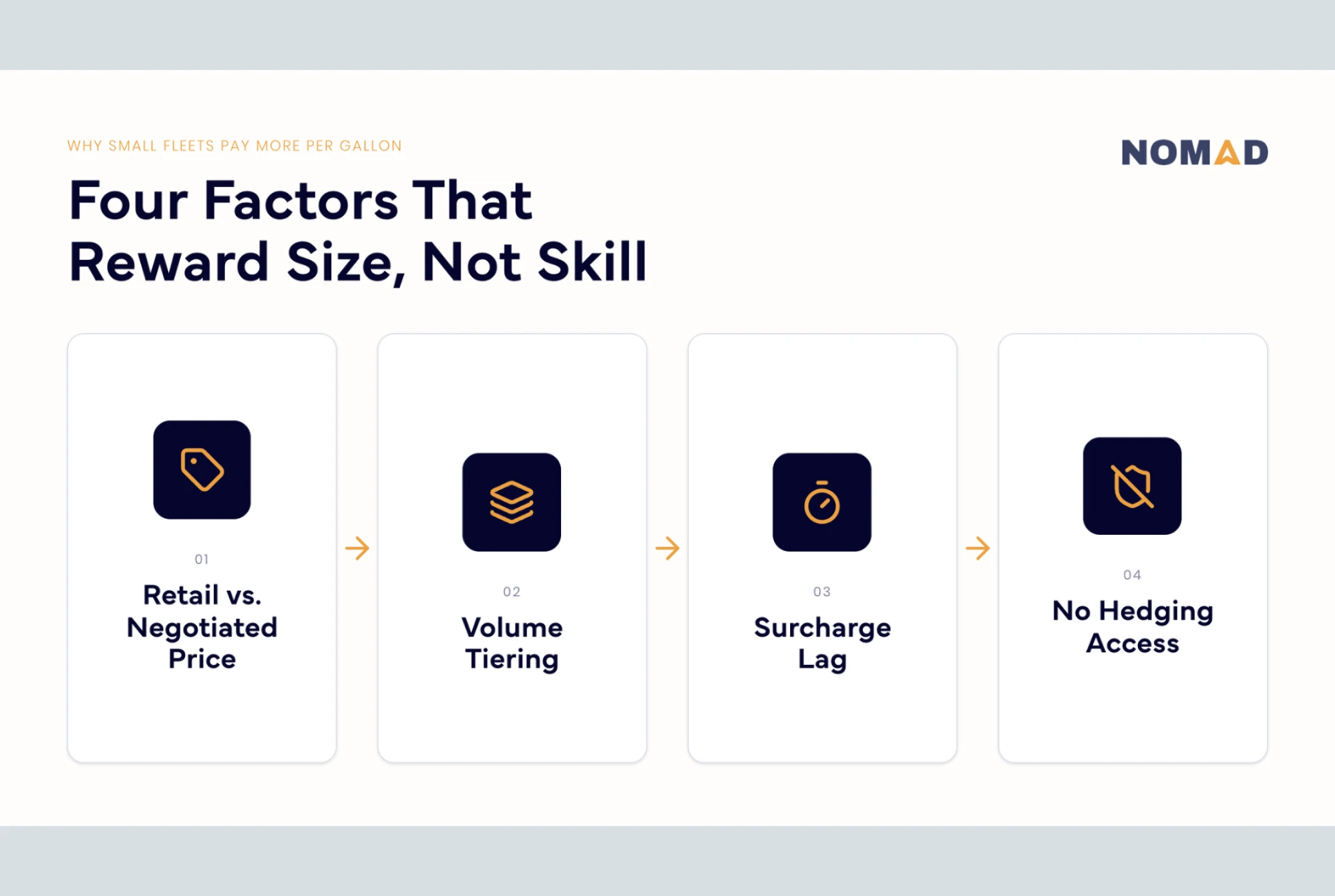
Image: Nomad
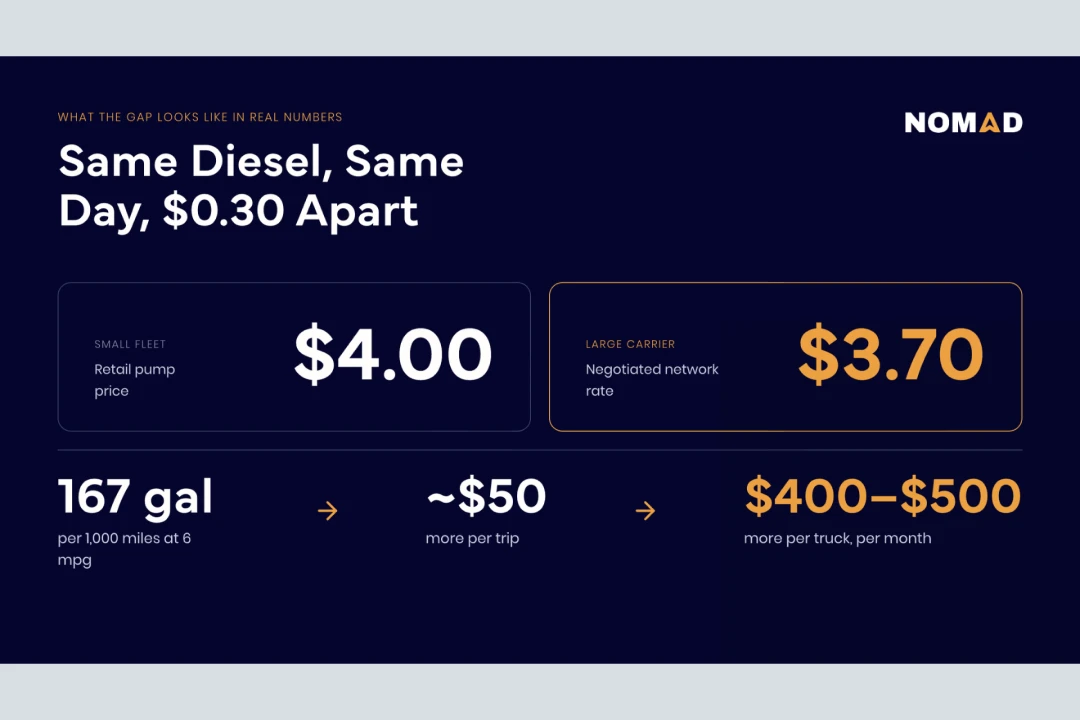
The four mechanisms above are easier to see when numbered. Say retail diesel is running at $4.00 a gallon. A large carrier with a negotiated network rate might pay as low as $3.70. That’s a $0.30 gap per gallon, and it holds steady across every fill-up, at every location in the network.
A truck that gets about six miles per gallon will use close to 167 gallons on a 1,000-mile run. With fuel priced $0.30 higher per gallon, that difference comes to roughly $50 on that single trip. Spread that over a vehicle driving 8,000 to 10,000 miles each month, and the same built-in price gap can drain several hundred dollars per truck monthly for a small fleet, even if every mile is driven efficiently.
This is a number that a fuel-cost calculator using national averages will never show, because it assumes everyone pays the same fuel price. Fleet fuel management systems that track actual per-gallon cost by location are the only way to see this gap clearly, rather than estimating it after the fact.
None of this means fuel efficiency doesn't matter. It does, and it's worth separating from the pricing mechanics above because the two problems get solved differently.
Fuel consumption is determined by controllable, day-to-day factors: route distance, driver behavior, and vehicle condition. Limiting unnecessary idling, keeping a steady speed rather than driving aggressively, and keeping tires properly inflated all reduce fuel consumption on their own.
These steps don’t address negotiated pricing, tier structures, surcharge timing delays, or access to hedging. They simply cut gallons per mile, which lowers overall exposure to those four forces.
For fleet managers estimating fuel costs for a trip, this distinction matters. A fuel cost calculator can tell you what a 500-mile or 1,000-mile trip should cost using an average fuel price and an assumed mileage figure.
But the actual number depends on two variables: the price paid per gallon, driven by the four mechanisms above, and the vehicle's and driver's fuel efficiency, which fleets can influence directly.
Improving efficiency reduces fuel usage. Improving access to better pricing lowers the fuel price. Fleet cost reduction that works long-term addresses both, rather than assuming one will fix the other.
The four pricing mechanisms in this post are things a small fleet can't outdrive, outplan, or outnegotiate on its own. Retail pricing, volume tiers, surcharge terms, and hedging access are structural, not behavioral. A five-truck operation can run the most fuel-efficient routes in the region and still pay more per gallon than a 500-truck fleet doing nothing special.
What actually narrows that gap is pooled volume. When smaller fleets combine their fuel-purchasing power through a shared network, they gain access to pricing tiers that would otherwise be out of reach. That's the mechanism, not a slogan.
This is where a fleet fuel card for small business models changes the equation. A network-based fuel card for small fleet operations aggregates purchases across thousands of participating locations, so a five-truck fleet buys fuel at rates closer to those of a much larger carrier. It's the same logic that drives volume tiering, just applied in the small fleet's favor.
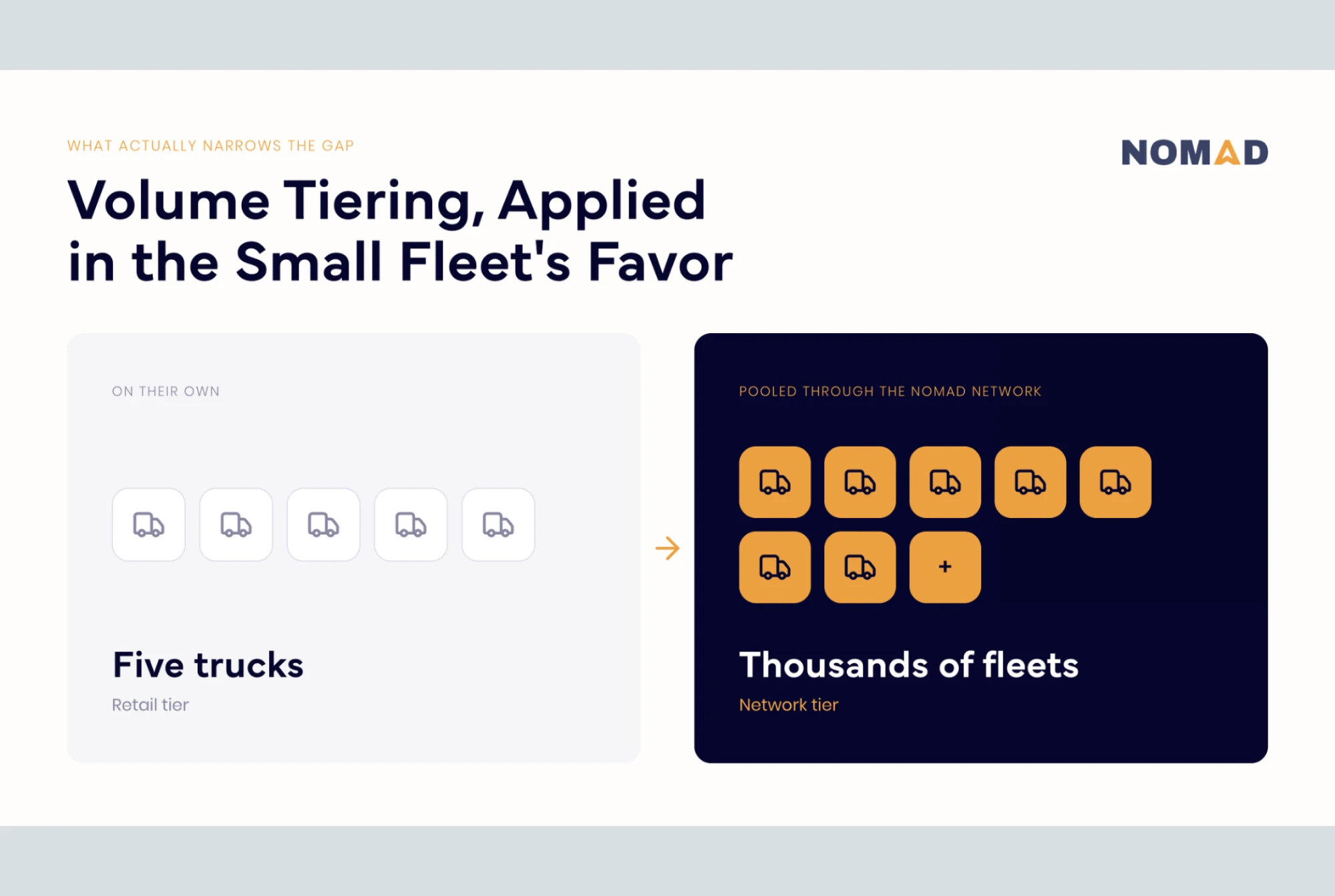
Image Source: Nomad
Fuel card savings, in this context, are not a discount on top of retail pricing. They are the result of a fleet no longer being priced at retail. That distinction is why pooled volume closes a structural gap that efficiency improvements alone cannot touch.
Nomad was built around this exact gap. The Nomad network gives small and mid-sized fleets access to negotiated fuel discounts at thousands of fuel stops across North America, with no monthly fees or deposit required. You can track transactions, set limits, and see open pricing tied to market patterns, the same visibility larger carriers already have.
If your fuel cost per mile has been climbing without an obvious reason, the mechanics in this post are likely the cause. Real fleet cost reduction starts with fixing the pricing gap itself, not just the mileage.
See how Nomad's network pricing compares to what you're paying now and what pooled volume could mean for your actual per-gallon cost.