Real-time visibility shows every fuel transaction, location, and price paid the moment it happens, letting long-haul fleet managers catch theft, off-network fills, and pricing errors before they eat into margin.
At 11 p.m., a truck sits idling at a fuel stop near Memphis. The card is declined. The driver is out of network and out of options, and no one at the office knows it yet.
That's the long-haul visibility problem: trucks stay on the road for days, and without real-time fuel monitoring, problems don't surface until the monthly invoice arrives.
Nomad closes that gap. Real-time visibility brings the same supply chain visibility that tracks freight in transit to your fuel spend, purchases, costs, and locations, so you see what's happening as it happens, not weeks later.
For long-haul carriers, the same real-time transportation visibility that tracks a shipment applies just as directly to fuel: the time between a problem and its discovery is exactly when the margin disappears.
Here's where that gap actually comes from, and what closing it looks like for fleets running long routes.
Long-haul routes mean greater distance, and that distance leads to blind spots. A truck traveling from Toronto to Dallas could stop for fuel many times before anyone at the office sees a single transaction. By the time the monthly statement comes in, it’s too late to track what happened.
When statements are delayed, so are answers. A $400 fill-up at 2 a.m. in another state might not surface for weeks, with no way to check who fueled up, which truck it was, or whether the price paid matched the pump price.
Paper receipts, manual processes, and disconnected fuel card data only make it harder to monitor fleet fuel consumption and see what's really happening on the road.
Every dollar spent on fuel stays hidden until it's already gone. Inflated prices, unauthorized fills, and duplicate charges don't show up until they're buried in a statement, by which point there's nothing left to do but dispute it.
The fix isn't more paperwork. It's closing the space between when a transaction happens and when someone sees it, so problems surface the same day, not the same month.
Real-time visibility gives you a live record instead of a paper trail. You don't have to wait for a statement to see each transaction as it happens, including which truck, which driver, the fuel stop, the exact location, and the amount spent, all tied back to a specific vehicle for full accountability.
Every fill is checked against the pump price the moment it posts, and fuel usage is mapped to each truck's route, so a purchase that doesn't fit stands out immediately.
Behind it, GPS tracking, IoT (Internet of Things) sensors, RFID (radio frequency identification), and machine learning cross-reference that data automatically, flagging suspicious activity without a manual audit. The same log doubles as a time-stamped record that holds up during a dispute, audit, or compliance review.
The result is a same-day catch, not a same-month dispute. A flagged fill at 2 a.m. means a phone call that night, not a data-hunting exercise weeks later. For managers running trucks across multiple routes, the dashboard consolidates scattered receipts into a single, clear source of truth.
Real-time visibility protects margin in four ways: it stops fraud as it happens, keeps drivers on-network, controls spend without micromanaging, and speeds up reconciliation and reporting.
Real-time visibility stops fraud before it becomes a costly problem. For a mid-sized, 100-truck fleet, even one unapproved $400 fill-up per truck each month adds up to $480,000 a year.
That aligns with industry findings: nearly 50% of surveyed trucking leaders said fuel fraud costs 5% of their total fuel spend. Individually, these losses look small enough to vanish into a monthly aggregate. Together, they're impossible to ignore.
Delayed reporting is what lets this go undetected in the first place. Live tracking flags suspicious activity the moment it happens, including off-network refueling, unusually large purchases, or a price that doesn't match the pump, so problems surface the same day instead of hiding in next month's statement.
Real-time visibility keeps drivers on-network, where every fuel discount actually pays off. You can see exactly where drivers are fueling up, catch off-network trends immediately, and fix the cause, whether that's limited coverage in an area or a habit that needs to change.
Linking transaction locations to route data does double duty: it flags fills that don't match where a truck should be, an early signal of a lost card, a shared login, or a driver drifting off-route.
Over time, this same fleet fuel monitoring data reveals patterns in driver performance, helping you tighten efficiency across every route, not just catch one-off fills.
Real-time visibility lets you control fuel spend without watching every driver, every day. Set the rules once, per-transaction limits, time-of-day restrictions, approved fuel stops, and the system enforces them at the point of sale, only flagging you when something falls outside them.
That shift is what matters: manual reviews and end-of-month spreadsheet audits become instant alerts instead. Drivers keep moving without extra hassle, and fleet managers step in only when a transaction actually needs attention, not on a fixed review schedule.
Pair it with telematics data like idling time, and the same real-time visibility extends past fuel spend to fuel efficiency and fuel economy across the fleet. The result is control without constant oversight, rules set once, data doing the monitoring, and your attention going only where it's actually needed.
Real-time visibility turns reconciliation from a month-end fire drill into a non-event. When every fuel purchase is captured, categorized, and geolocated as it happens, finance teams pull clean reports without chasing lost receipts or correcting totals that don't add up.
That accuracy compounds. Fewer manual steps, faster closing cycles, and decisions built on data rather than guesswork are all first-order effects of fuel data living within the same real-time workflow as the rest of the fleet.
For finance-focused fleet managers, this is where real-time visibility pays for itself fastest: less time spent reconciling, more time spent on the numbers that actually drive decisions.
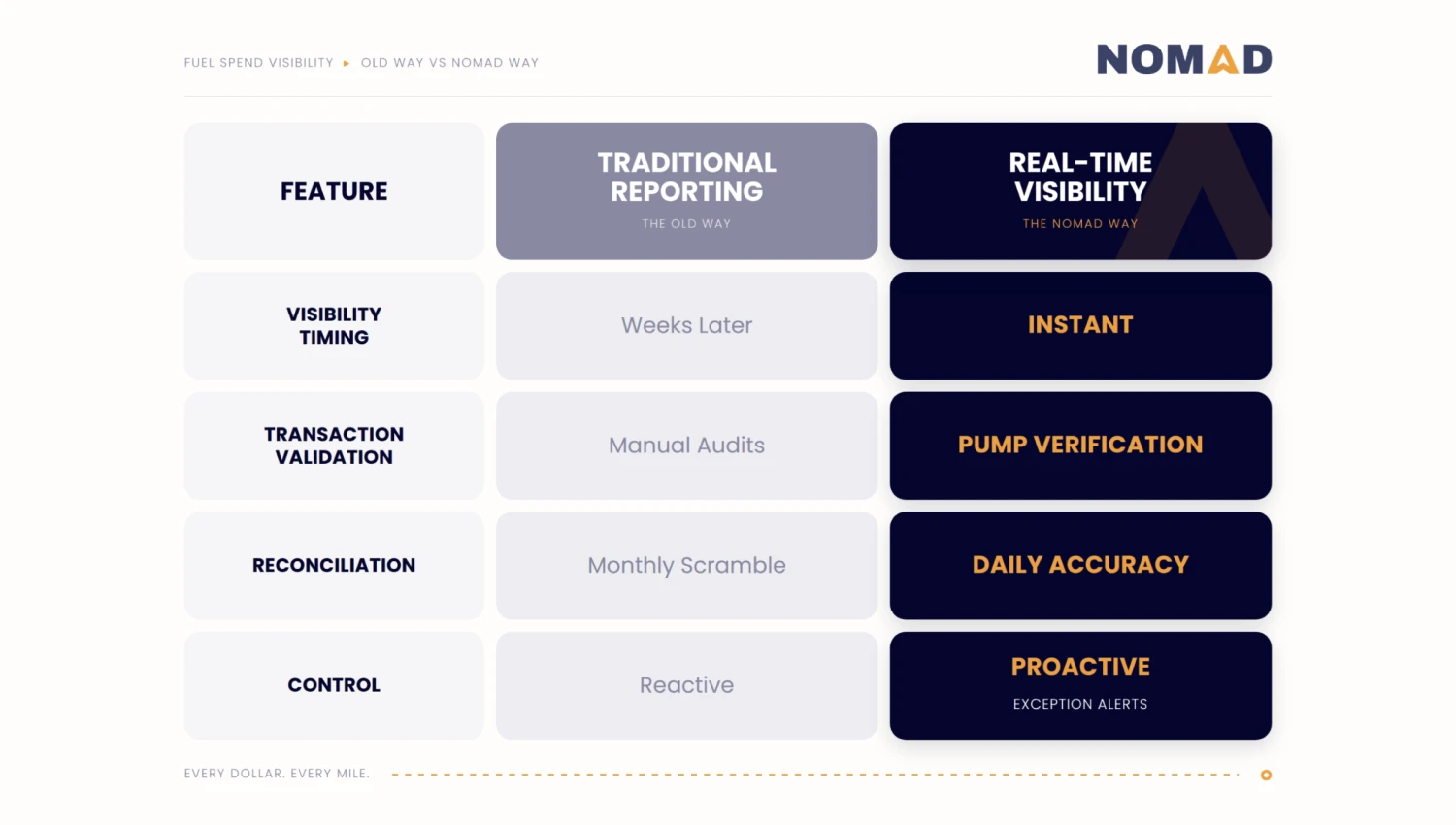
Image Source: Nomad
Nomad’s fleet fuel management system delivers real-time visibility for long-haul fleets in three ways: a network big enough to keep drivers on it, per-driver controls that flag issues instantly, and fraud detection accurate enough to trust.
Nomad's network covers over 10,000 truck stops across the U.S. and Canada, built specifically for fleets that don't come home every night. Wherever a route runs, drivers stay in-network, and every fill is tracked the moment it happens, rather than showing up on next month's statement.
The same network powers a live fuel map with pricing down to the truck stop level, so drivers can plan fuel stops based on real prices rather than guesswork. For long-haul routes in particular, wide coverage paired with live pricing keeps trucks moving without costly detours.
Every Nomad fuel card is assigned to a specific driver, so every transaction ties back to a person, not just a vehicle.
When a fill falls outside an approved location, spending limit, or fuel stop, Nomad flags it the moment it posts, and fleet managers can approve or block the transaction on the spot instead of catching it during a review.
That control lives on one dashboard, the core of any fleet fuel management software: every transaction tracked, every anomaly flagged, so nothing slips through the cracks between the pump and your report.
Nomad's AI-powered fraud detection has already stopped millions in unauthorized spending across the network, catching unusual fuel purchases before they clear. Beyond flagging suspicious transactions, the system also tracks rejections at the driver level, so a pattern of declined attempts gets caught before it becomes a bigger problem.
That accuracy shows up in the numbers: 99.9% transaction accuracy means fleet managers get a reliable, real-time view of fuel costs instead of reconciling guesswork every month. The sooner a bad transaction is caught, the sooner it stops costing you.
Long-haul fleets can't afford to discover fraud, off-route fills, or pricing issues weeks later. Real-time visibility and fleet fuel monitoring close that gap, helping you reduce fuel costs and protect your margins with every transaction.
See what real-time visibility looks like for a fleet running your routes, and talk to the Nomad team.